
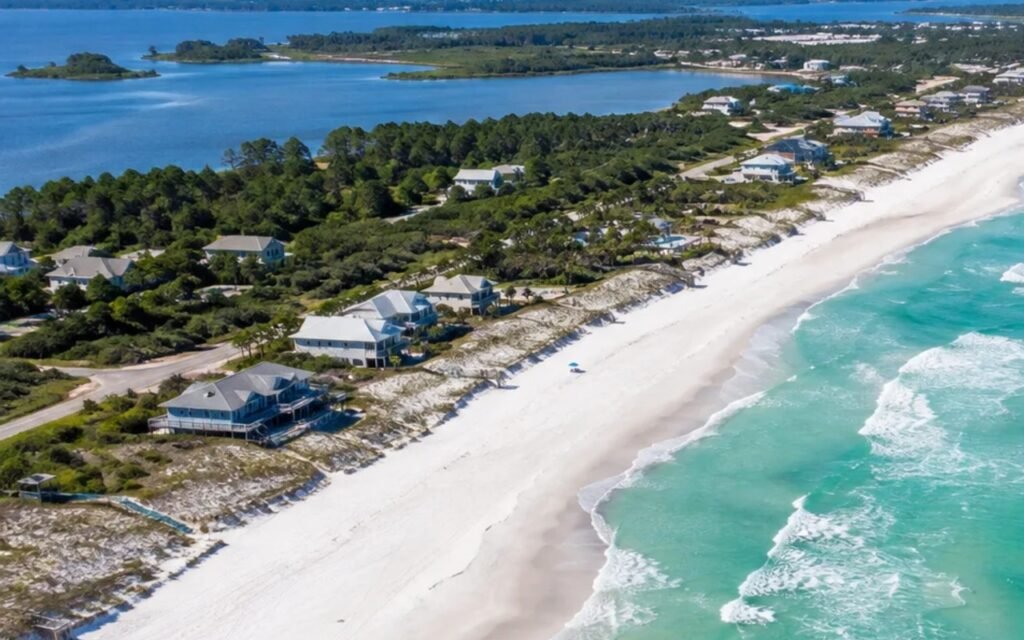
30A is shorthand for a stretch of Walton County coast, and the first thing worth knowing is that it is not one place. The communities strung along it were built at different times by different people under different rules, and almost none of them are a town in any legal sense. There is no city hall on 30A. Every community here sits in unincorporated Walton County, which means the rules that shape what you can build, how tall, how close to the water and whether you can rent it out come from two places: the county land development code, and whatever private covenants were written into your particular neighborhood.
This is the community-by-community walk we promised in our Buyer’s Guide to the Florida Panhandle.
The road itself
County Road 30A runs between two points on U.S. 98, south of the highway and roughly parallel to the shoreline. Sources do not agree on its length: AARoads puts the road centerline at 18.56 miles, while the state’s own byway program describes a designated corridor of 24 miles. It became a Florida Scenic Highway in April 2008 and received National Scenic Byway designation in 2021.
One practical wrinkle before you start reading listings. “Santa Rosa Beach’ is both a named neighborhood on 30A and the mailing address for a large share of the whole corridor, ZIP code 32459. A property advertised as Santa Rosa Beach may sit nowhere near the Santa Rosa Beach neighborhood. Read the community name, not the postal city.
West to east
Dune Allen is the westernmost. Three coastal dune lakes sit within it — Stallworth, Dune Allen and Oyster — along with walking trails and its own regional beach access. It is an older platted area rather than a master-planned development, so there is no single design code covering it.
Gulf Place is a mixed-use town center sitting directly across 30A from the beach, with restaurants, shops, an open-air artist colony and the Gulley Amphitheater.
Santa Rosa Beach, the neighborhood, is the oldest settled part of this stretch by the tourism bureau’s account, which dates it to 1910. Local history adds nuance: a Santa Rosa post office opened in 1910, but the Santa Rosa Beach post office itself was not created until 1955, and nearby settlements predate the 1910 plat.
Blue Mountain Beach takes its name from the native blue lupine that grows there. Redfish Village is its shopping and dining node, and Point Washington State Forest sits behind it.
Grayton Beach is the oldest village on 30A. A homestead was built here around 1885 by Major Charles T. Gray; streets and blocks were laid out after 1890, and W.H. Butler bought most of the village land around 1913. It reads differently from its neighbors — narrow streets, live oaks, old wooden bungalows — and it carries a rule the rest of the coast does not. The county height cap in Grayton Beach is 40 feet, against 50 feet for the rest of South Walton south of the bay. If you are buying a lot here with a build in mind, that ten feet is the difference between three stories and something less.
WaterColor was developed by The St. Joe Company, established in 1999 on 499 acres and planned by Cooper, Robertson & Partners. Control passed from the developer to the homeowners association in 2013, and St. Joe reports all remaining homesites sold, so what is left of the developer’s involvement there is hospitality and commercial rather than lot sales. It fronts Western Lake, the same dune lake that Grayton Beach State Park encompasses.
Seaside is the one most people have seen without knowing it. Robert Davis inherited 80 acres his grandfather had bought in 1946, and construction began in 1981 with two houses and one street. Andrés Duany and Elizabeth Plater-Zyberk planned it; Leon Krier contributed. They wrote what the University of Notre Dame’s research portal calls the first form-based code since Haussmann’s Paris — seven lot types governing building size, materials, colour palette, porches, picket fences and window proportion. Duany and Plater-Zyberk went on to co-found the Congress for the New Urbanism in 1993. The town was the filming location for The Truman Show in 1998, which also prompted the enduring criticism that a code that tight produces a set rather than a town. Counts of what is actually there vary: the Congress for the New Urbanism cites 423 residential units, 42 shops and 12 restaurants; Seaside’s own site says over 300 homes.
Seagrove Beach came from C.H. McGee Sr., who bought 160 acres of beachfront in 1949 for $75,000. The road to Highway 98 was paved in 1950 and telephone service arrived in 1958. McGee wrote covenants and restrictions early, and in 1953 his family donated four beach accesses and roughly 750 feet of beachfront to Walton County. It is a mix of older homesteads and newer cottages under a canopy of oaks, magnolias and sand pines, with two dune lakes.
WaterSound is where buyers get confused, and it is worth slowing down. St. Joe uses the name for five different developments and only two of them are on 30A: WaterSound Beach, gated, at the eastern end, built in a New England shingle style with a long curving boardwalk over the dunes and Camp Creek Lake at its edge; and WaterSound West Beach, also gated, just west of it. WaterSound Origins, WaterSound Camp Creek and the Watersound Town Center are all north of U.S. 98 — a different setting entirely, with golf and a Publix rather than a beach walk.
Seacrest Beach was established in 1996 on 78 acres and planned for roughly 400 homes. The owners association took control from the developer in October 2004. Its centrepiece is a 12,000-square-foot lagoon pool holding 378,000 gallons. The buyer point here is structural: Seacrest is not beachfront. Access is deeded, by a pedestrian boardwalk through the neighbouring community across 30A, plus a seasonal tram from March to October.
Alys Beach is the white one. EBSCO Industries bought the land in 1978; the master plan is dated 2003 and the town was established in 2004, named for Alys Stephens. DPZ planned it for 159 acres and 899 residential units, drawing on the courtyard houses of Antigua, Guatemala and the white walls and roofs of Bermuda. The white masonry is not a trend, it is the code. The Alys Beach Design Code is enforced by an Office of the Town Architect, held since 2003 by Erik Vogt and Marieanne Khoury-Vogt, and review begins when you choose a lot and continues through construction. Homes are built to FORTIFIED for Safer Living and Florida Green Building standards.
Rosemary Beach began in 1995 on 107 acres, developed by the Rosemary Beach Land Company. DPZ again, with Seaside’s town architect Richard Gibbs directing the opening charrette. The master plan sets twelve lot types. The architecture reaches for the West Indies and the Caribbean by way of New Orleans and St. Augustine — deep eaves, steep roofs, shuttered openings, elevated masonry porch bases, and a deliberately varied colour palette so that homes harmonise without matching. The property owners association keeps a Town Code and Regulating Plan, architectural review, covenant enforcement and townscape committees, and a contracted town architect.
Inlet Beach is the eastern end, and the least uniform. Robert E. Hicks bought 185 acres here in the 1920s; after the war a veterans’ lottery distributed 1.25-acre parcels on the condition the buyer built an 800-square-foot house and paid a $50 fee. Today it runs from rustic cottages to modern multi-storey houses, with the 30Avenue shopping centre and what the county tourism office calls the largest regional beach access in South Walton. There is no community-wide design code.
The dune lakes, and why they shape a lot
Coastal dune lakes are the genuinely unusual thing here. They sit near the shore and connect intermittently to the Gulf through an outfall, so salinity rises and falls with tide and weather. Walton County describes them as occurring only in Madagascar, Australia, New Zealand, Oregon and Walton County; Florida State Parks phrases the same rarity as four countries worldwide. The county counts 15 named dune lakes along 26 miles of coastline, of which the Friends of Scenic 30A count 11 along 30A itself.
They are also a hard constraint on building. The county’s Coastal Dune Lake Protection Zone extends 300 feet landward from the lake’s high water line. Inside it, at least 60 percent of your parcel must stay pervious, clearing of native vegetation is capped at 50 percent, and no construction or clearing at all is allowed within 100 feet of the water line except boardwalks, docks and shoreline access — with a narrow exception for lots of record established before November 1996. Septic drain fields must sit at least 100 feet back. Seawalls, bulkheads and rip-rap are prohibited. A lakefront lot can be considerably less buildable than its dimensions suggest.
What the county code does to a 30A lot
Beyond any private covenants, Chapter 13 of the county code governs the whole 30A scenic corridor, and several of its rules surprise people:
- A 65 percent width rule. On lots adjacent to the south side of 30A with a Gulf view corridor, the total width of structures may not exceed 65 percent of the width of the lot. On a Gulf-side parcel this shapes the house before an architect touches it.
- A 20-foot scenic corridor setback from the right of way, with existing vegetation inside it preserved as part of a landscape plan.
- Fences. Walls, chain link and wire fencing are prohibited along the entire corridor. Fences run between three and six feet, and on Gulf-view properties must keep that same 65 percent see-through ratio.
- Height. Fifty feet south of the bay, 40 feet in Grayton Beach, 32 feet in Point Washington, measured from average natural ground under the building footprint.
- Dunes and the state line in the sand. The Coastal Protection Zone limits disturbance to ten percent of existing dune vegetation. Seaward of the state’s Coastal Construction Control Line, the county will not issue a building permit at all without a Notice to Proceed from the Florida Department of Environmental Protection, and habitable structures and pools there need piling foundations certified by a licensed engineer.
Some of these figures come from the 2019 revision of the code, which has been amended since, so confirm the current text for a specific parcel rather than relying on a summary.
Renting it out
Short-term rental in unincorporated Walton County is a registration programme, not a free-for-all. Ordinance 2023-03 requires registration for any unit rented more than three times a year for periods under 30 days, unless it falls within a listed exemption. Before the county will register you, you need a Florida Department of Revenue account, a state vacation rental dwelling licence from DBPR, and a tourist development tax account with the Clerk of Courts.
Fees since February 2025 run $300 a year for an individual property and $227 for a community registration, with a $500 per day penalty for operating unregistered. Occupancy is capped at one person per 150 square feet of conditioned space. New construction is required to provide one parking space per 900 square feet. A local responsible party must be reachable 24 hours a day and able to be at the property within one hour.
The renewal schedule changed in February 2026 and now aligns with the state licensing cycle: applications open April 1, renewals are due June 1, and the registration year runs June 1 to May 31. Properties in ZIP code 32459, the Santa Rosa Beach area, stay on their old cycle until further notice, so renewal timing is not uniform along the corridor.
And the rule that catches people: county registration says nothing about whether your neighbourhood allows it. Private covenants can prohibit or restrict short-term rental entirely, independently of the county. Read the covenants before you count on rental income.
The beach itself
This is the part of Walton County that has been in dispute for a decade, and a buyer should understand where it actually stands rather than what anyone says at a showing.
The county adopted a customary use ordinance in 2016, effective April 2017, protecting public use of the dry sand. A 2018 state law required the county to establish that right through the courts instead. In June 2023 the county settled with beachfront owners, limiting public use to a transitory zone 20 feet landward of the wet sand between 9 a.m. and 4 p.m. In March 2024 the First District Court of Appeal upheld a finding that the county had abandoned customary use for one subdivision, while declining to strike down the statute or the doctrine. In June 2025 the Governor signed CS/SB 1622, repealing the 2018 statute — which, as the county’s own attorney put it at the time, changed nothing on day one. The county has since passed a resolution affirming support for public beach use, but not a new ordinance.
So: public rights below the mean high water line are not in dispute. Rights to the dry sand seaward of a private beachfront parcel depend on that parcel — whether it was covered by the 2023 settlements, whether a quiet title action has been filed, and what the deed says. If you are buying beachfront, have a lawyer read the deed, the plat, and any judgment or settlement affecting the property. If you are buying anything else, get it in writing how your beach access is actually delivered: deeded easement, association-owned access, tram, or a public access down the road.
Before you commit to a lot
The same short list applies almost everywhere on 30A. Get the recorded covenants and any design code or regulating plan. Get current and pending assessments. Find out who reviews design, how long it takes, what it costs, and whether an approved builder list applies. Confirm in the covenants whether short-term rental is permitted at all. Put the survey against the dune lake protection zone, the coastal protection zone and the control line. And check the height cap and, on a Gulf-side lot, that 65 percent width rule.
Florida law is on your side for one piece of this: a seller in a mandatory homeowners association must give you a disclosure summary, and the contract is voidable within three days of receiving it or before closing, whichever comes first. That right cannot be waived, and it ends at closing.
Little Ranch Realty works this coast and the rest of Florida at every price point. If you are looking at a specific community or a specific lot on 30A and want a straight read on what you are actually buying, we are happy to go through it with you.