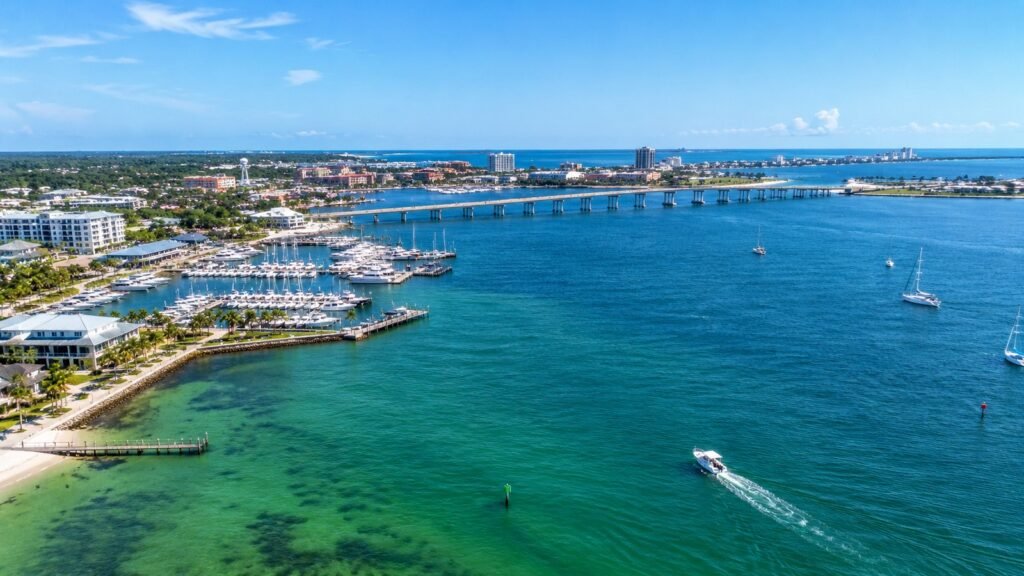
In our Buyer’s Guide to the Florida Panhandle we said downtown Pensacola has the most active development pipeline on this coast. This is the closer look we promised: what the city’s redevelopment agency actually is, where the Maritime Park project stands today, what else is being built around it, and what any of it means if you are thinking about buying downtown.
First, what a CRA actually is
A lot of downtown headlines mention “the CRA,” and it is worth knowing what that is before reading any of them. Florida law, in Chapter 163, Part III of the Florida Statutes, lets a city set aside a defined area for redevelopment and create a Community Redevelopment Agency to run it. In Pensacola, the seven members of City Council sit as the agency’s board.
The money works through something called tax increment financing. When a district is created, the taxable value of property inside it is locked in as a base. As values rise over the years, 95 percent of the extra property tax that the participating taxing authorities collect on that growth goes into a trust fund that can only be spent inside that district, under an adopted plan and an annual budget.
Two points are easy to miss. First, it is not a new tax. An owner inside a CRA district pays the same millage as an owner outside it. What changes is where part of that money goes. Second, the rules tightened in 2019. Florida now requires CRA board members to take annual ethics training, requires audits and an annual budget, and requires each agency to post an annual report online by March 31. Most CRAs that existed in 2019 end by 2039 unless the government that created them votes to keep them.
For a buyer, that annual report is one of the most useful public documents in the city. It lists what was spent, where, and on what.
Pensacola’s three districts
Pensacola’s CRA was created in 1980. In August 2020, City Council voted to extend the agency through 2046. It runs three tax-increment districts:
- Urban Core, about 1,308 acres, which takes in the historic downtown and the waterfront.
- Westside, about 1,141 acres.
- Eastside, about 257 acres.
The city publishes maps of all three, and they are worth pulling up before you look at a specific address, because the lines do not always fall where you would guess.
In fiscal year 2025, the agency reported about $10.3 million in spending across the three districts and 71 projects started or completed. About $8.4 million of that was in the Urban Core. Its named programs include residential property improvement, residential resiliency and several affordable housing initiatives.
In June 2026, the city floated the largest CRA expansion in about 20 years, roughly 2,755 acres across three study areas, including the Sanders Beach and Bayou Chico area. It was pulled from the June agenda and has not moved forward since. If you are looking in those areas, it is worth following.
Maritime Park and the Lot 5 project
Pensacola voters approved the Community Maritime Park in a 2006 referendum, and the Blue Wahoos played their first game at the ballpark in April 2012. Several parcels around the stadium have sat undeveloped since. The one getting the attention now is Lot 5.
In August 2024, the city approved a 100-year lease for a mixed-use project on Lot 5. The development group includes Inspired Communities of Florida and The Dawson Company, EJ Smith Enterprises and Corporate Contractors Inc. In December 2025, the Planning Board unanimously approved the design: a 12-story, 147-room Reverb by Hard Rock hotel and a 16-story residential tower of roughly 247 units.
This spring the developers asked the CRA for a tax rebate of about $2.9 million a year for 20 years. The mayor opposed it, and in April 2026 the CRA board voted it down. As of July 2026, the project was reported to be going ahead without the rebate, privately financed at about $310 million, with groundbreaking targeted before the end of 2026. The lease requires substantial completion by June 30, 2028.
The figures on this project have shifted as plans developed. Earlier reports gave different costs and unit counts. The numbers above are the most recent we could confirm. Until a groundbreaking actually happens, treat every date as a target.
What else is being built around it
Maritime Park gets the headlines, but several other projects will do as much to change how downtown works day to day.
- Palafox Street. The $10 million “New Palafox” project rebuilt stormwater and accessibility on Palafox from Garden Street to Main Street, including more than 1,700 feet of new drainage pipe. The street was closed for 139 days and reopened to cars on June 1, 2026. More phases are scheduled further south.
- Garden Street. An FDOT project of about $21.5 million covers Garden Street from Pace Boulevard to the I-110 ramp, projected to finish in mid-2027.
- The Hashtag. The city’s “Hashtag” Waterfront Connector plans to rework Main and Cedar Streets where they cross Palafox and Jefferson to better connect downtown to the water. It is still in design.
- Hotel Tristan. A 122-room, seven-story hotel at 98 N. Jefferson Street in the East Garden District broke ground in November 2024. The hotel’s own site now lists an early 2027 opening.
- American Magic. The America’s Cup sailing team opened a $20.8 million, 56,000-square-foot high performance center in Warehouse 10 at the Port of Pensacola in January 2026.
- New housing. The Helm at Hawkshaw, a seven-story building with 227 units, is contracted to start construction by mid-October 2026. On East Jackson Street, a 12-townhome project includes five affordable homes through a community land trust.
If you are buying in a historic district
Much of downtown and the neighborhoods around it sit inside locally designated historic districts: the Pensacola Historic District, the North Hill Preservation District, the Old East Hill Preservation District, the Palafox Historic Business District and the Governmental Center District.
Inside those districts, the city’s seven-member Architectural Review Board must approve exterior alterations, new construction, the demolition of contributing structures, signs and fences. That does not make a historic home a bad purchase. It means that if you plan to change the outside of the building, the review is part of your timeline and your budget. Before you buy, confirm whether the property is inside a district and whether it is listed as a contributing structure, and read the district guidelines for the kind of work you have in mind.
What it means for a buyer
We do not predict prices, and nobody honestly can from a project list. But a few things are clear from the public record.
- The city has committed to the long term. An agency authorized through 2046, a trust fund that can only be spent inside its districts, and multi-year street projects all point to a horizon measured in decades.
- Construction comes with disruption. Street closures, detours and noise are part of living near active projects. If you are buying near one, ask what is scheduled next and for how long.
- New supply changes the math. Several hundred new rental units and hotel rooms within a few blocks will shape rents and nightly rates nearby. If rental income is part of your plan, underwrite with that in mind.
- The paperwork is public. CRA reports, district maps, Planning Board agendas and ARB guidelines are all published by the city. Ask for them, or ask us to pull them.
Little Ranch Realty works across the Florida Panhandle, at every price point. If you are looking at a specific block, building or historic home in downtown Pensacola and want a straight read on what is planned around it, we are happy to go through it with you.