If you are looking at the Florida Panhandle for the first time, it helps to know that this is not one market. The stretch of coast from Pensacola east to Panama City covers barrier islands, working downtowns, bayfront neighborhoods and inland towns — and each one is priced, built and zoned differently. A condo on Navarre Beach and a cottage three miles inland can sit in the same county and have almost nothing else in common.
This guide is the overview. It walks through the coastal communities, the downtowns where public and private money is currently going, where new construction is happening, and the practical items a buyer should look into before narrowing a search. Over the coming weeks we will take each of these sections and go deeper in its own Ranch Report post.
The coastal communities
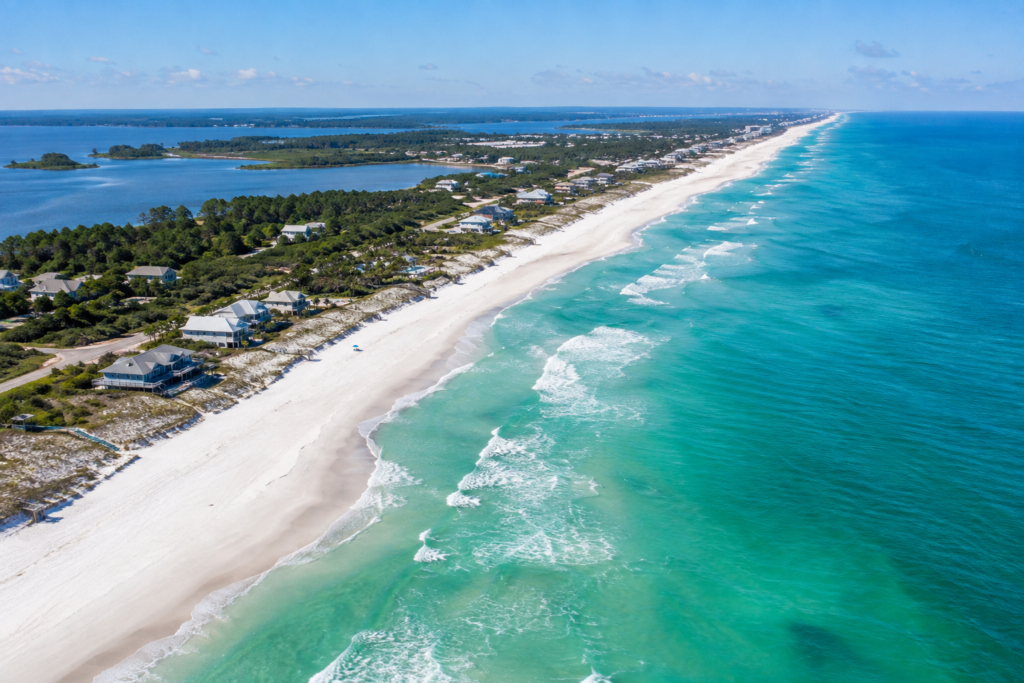
The Panhandle coast runs roughly west to east: Perdido Key, Pensacola Beach, Navarre Beach, Okaloosa Island and Fort Walton Beach, Destin, the 30A communities in South Walton, and Panama City Beach. They share the white sand and the green water. They differ in density, in the mix of condominiums versus single-family homes, and in how much of the housing stock is used as short-term rental.
30A in South Walton is the most master-planned stretch of the coast — a string of small beach communities including Seaside, Grayton Beach, Seagrove, Rosemary Beach and Alys Beach, most built around walkable town centers and subject to design guidelines that shape how homes look. Destin sits just west of it with a working harbor and a larger year-round commercial base. Navarre Beach, on a barrier island in Santa Rosa County between Pensacola and Destin, is lower-density and remains unincorporated county land with no municipal government of its own.
One item specific to Navarre Beach and Pensacola Beach deserves its own mention, because it surprises buyers: property on Santa Rosa Island is generally leasehold rather than fee simple. The land itself is owned by Escambia County under a federal deed restriction dating to the 1940s, and in 1956 the Navarre Beach portion was leased to Santa Rosa County, which sub-leases parcels to owners. You buy the structure and hold a long-term land lease beneath it. Owners do pay county property taxes, settled by a 2014 Florida Supreme Court ruling, and there have been repeated efforts to convert leaseholds to fee simple title, but that conversion is not finished. If you look on either island, read the lease — its terms and remaining years — as carefully as you read the survey.
Pensacola Beach and Perdido Key anchor the western end, within a short drive of downtown Pensacola. Panama City Beach on the eastern end is lined with high-rise condominium buildings along its beachfront.
Now published: 30A community by community — how Seaside, Alys Beach, Rosemary Beach and the rest differ, and what their design codes mean for a buyer.
The downtowns drawing investment
A lot of Panhandle buying attention goes straight to the beach. The downtowns are where a good deal of current public and private investment is going.
Pensacola has the most active downtown development pipeline on this coast. The city’s Community Redevelopment Agency runs three tax-increment districts — Urban Core, Westside and Eastside — and is authorized to continue that work through 2046, reinvesting rising property tax revenue inside each district. On the waterfront at Maritime Park, a mixed-use project combining a Reverb by Hard Rock hotel and the Rhythm Lofts apartments is targeting a groundbreaking by the end of 2026, with the hotel slated to open in 2029. In the East Garden District, Hotel Tristan, a 122-room hotel, is set to open in late 2026. Separately, the sailing team American Magic opened a $20.8 million, 56,000-square-foot high performance center at the Port of Pensacola in January 2026, which the team has described as its permanent base.
Fort Walton Beach is working through a Downtown Master Plan focused on the Miracle Strip Parkway corridor, where the volume of Highway 98 traffic has long shaped how the historic main street functions. The Fort Walton Beach Landing, the city’s waterfront park on Santa Rosa Sound, reopened in April 2026 after a multi-year, roughly $8 million renovation that added a reinforced seawall, a concrete boardwalk, a performance stage with amphitheater seating and expanded parking. The city’s redevelopment agency also runs facade grant and streetscape programs downtown.
For a buyer, downtown investment is worth tracking for a simple reason: it shows where a city is committing money over a ten- and twenty-year horizon, and it tends to show up in walkability, dining, parking and public space before it shows up anywhere else.
Coming in a future Ranch Report: downtown Pensacola in detail — the Maritime Park project, how a community redevelopment agency actually works, and what it means for the surrounding area.
Where new construction is happening
New building on this coast falls into two broad patterns. West of Destin, most of it is single-family and small-subdivision construction — Navarre, Gulf Breeze, Milton and the corridors north of Highway 98. East of Destin, through Miramar Beach, Santa Rosa Beach, Freeport and the 30A area, there is a steady flow of both subdivision building and one-off custom homes on individual lots.
Public projects matter here too. On Navarre Beach, Santa Rosa County has been planning a boardwalk and event hall complex east of the Navarre Beach Pier, funded from tourist development tax reserves. The project went out for bid in 2026 and has drawn organized opposition from a group of residents, so the timeline and final scope are still unsettled. If you are looking on that island, it is worth following where it lands.
If you are considering new construction anywhere here, the questions that matter most are the unglamorous ones: who the builder is and what the warranty covers, what the HOA or condominium association budget and reserves look like, and whether the community is fully built out or still has phases to come.
Coming in a future Ranch Report: buying new construction on the Emerald Coast — builder contracts, deposits, warranties and what to ask before you sign.
Looking inland
Some of the most practical options on this coast are not on it. Gulf Breeze, Navarre proper, Niceville, Crestview, Milton and Freeport all sit within a reasonable drive of the water and generally carry different price points and different lot sizes than the beachfront communities do. Buyers who want more square footage, more land, or a neighborhood with more year-round occupancy than short-term rental often end up looking at these areas.
Drive time is the thing to measure honestly. Highway 98 is the main east-west route along the coast and it backs up seasonally. Bridges matter too: the two-lane Navarre Beach Causeway Bridge opened in 1960 and is listed by the Florida Department of Transportation as functionally obsolete, meaning it no longer meets current design standards. Replacement estimates have run from roughly $150 million to $350 million, and Santa Rosa County has been working through funding options, including a possible toll. If a daily commute across that span is part of your plan, factor it in.
Coming in a future Ranch Report: living close to the coast without buying on it — a look at the inland towns and what the drive times really are.
What to check before you narrow the search
Whatever part of the Panhandle you land on, a handful of items shape cost and usability more than anything else:
- Flood zone and elevation. Much of this coast is in a mapped flood zone, and the zone and elevation certificate drive insurance cost. Get both before you get attached to a property.
- Wind mitigation and roof age. Insurance in coastal Florida is priced heavily on construction details — roof age, roof-to-wall attachment, opening protection. A wind mitigation inspection can change a premium substantially.
- Short-term rental rules. These are set locally and vary by county, city and association. If rental income is part of your plan, verify what is permitted at the specific address, not just in the general area.
- Association documents. For condominiums especially, read the budget, the reserve study and any pending special assessments. This is where the real cost of ownership shows up.
- Utilities and access. Inland and semi-rural properties may be on well and septic rather than municipal service, and access easements are not always where you assume.
Coming in a future Ranch Report: flood zones and insurance on the Panhandle coast — how to read an elevation certificate and what actually moves a premium.
Where to start
The most useful first step is usually narrowing the “why” before the “where.” A year-round residence, a second home and an income property point toward different parts of this coast, and the differences are mostly practical — rental rules, association structure, drive times, insurance. Once that is clear, the search gets a lot shorter.
Little Ranch Realty works across the Florida Panhandle, at every price point. If you are starting to look at this area and want a straight answer about a specific town, neighborhood or property, we are happy to talk it through.